Which chords belong to a major key?
Build one chord from every degree of the major scale and the chord qualities follow this pattern: I major, ii minor, iii minor, IV major, V major, vi minor, and vii diminished.
In C major that gives C, D minor, E minor, F, G, A minor, and B diminished. The Roman numeral tells you the chord's role and lets the same pattern move to another key.
Map the harmony on the fretboard
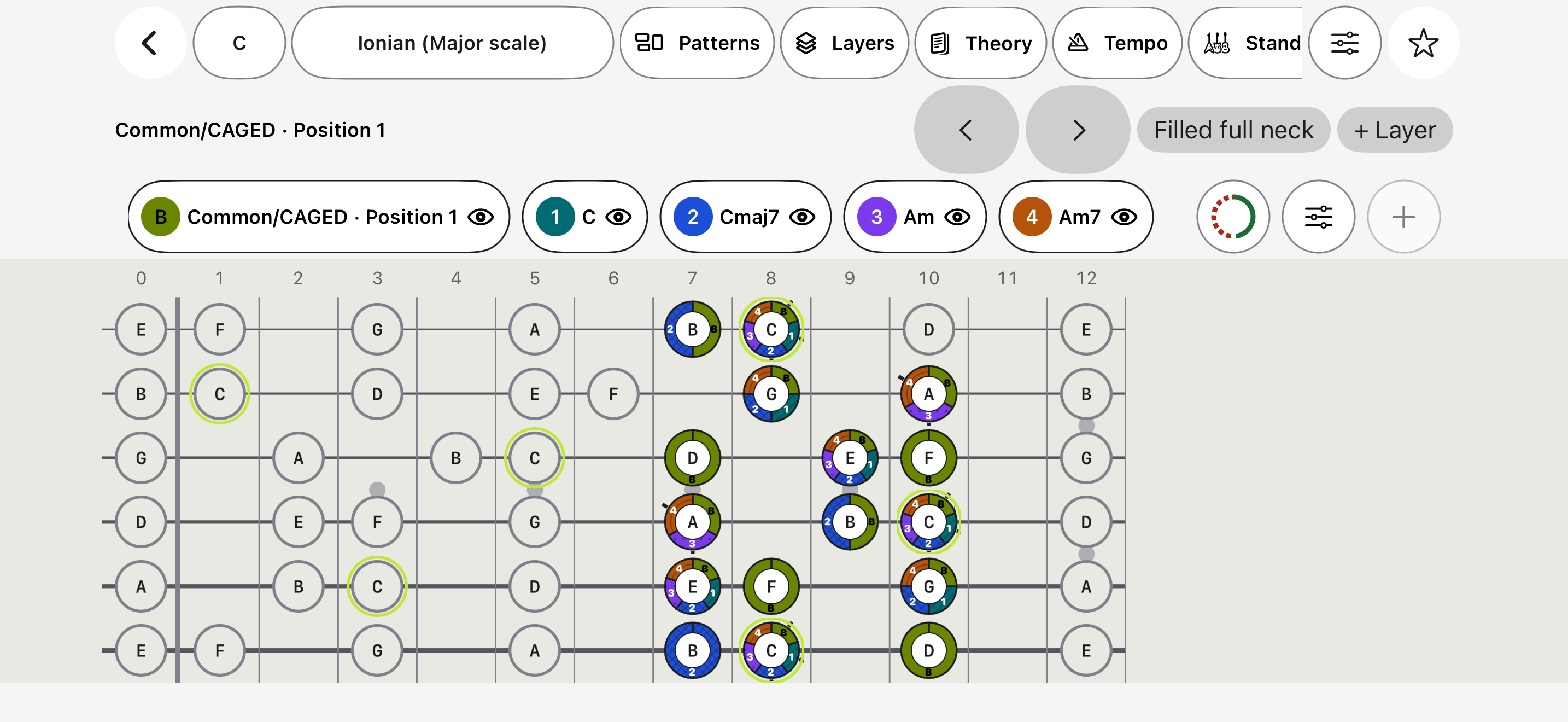
Select a key in NeckPilot, open Theory, and inspect the harmonized scale. Then choose a chord to see where its tones occur across the neck. Keep the root visible so you can relate each chord back to the key centre.
- Choose the root and major scale in Explorer.
- Open Theory and review the seven diatonic chords.
- Select one chord and name its root, third, and fifth before playing it.
- Compare two neighbouring chords and look for shared tones.
- Play a short progression slowly, then repeat it in another area of the neck.
Start with progressions you can hear
Try I-IV-V-I to hear a clear return to the tonic, or I-V-vi-IV for a longer loop. Do not rush through all seven chords. Two or three well-heard changes teach more than a diagram you cannot yet connect to sound.
A metronome or drum beat can keep each change honest. Begin with one chord per bar, then shorten the time only when the transitions stay clean.
Chord tones are not chord shapes
A fretboard marker says that a note belongs to the selected chord. It does not guarantee that every marked combination is a practical voicing. Choose a playable set of notes, avoid unnecessary stretches, and listen for a clear bass note and smooth movement between chords.